
Bubble
🌐 Website Preview
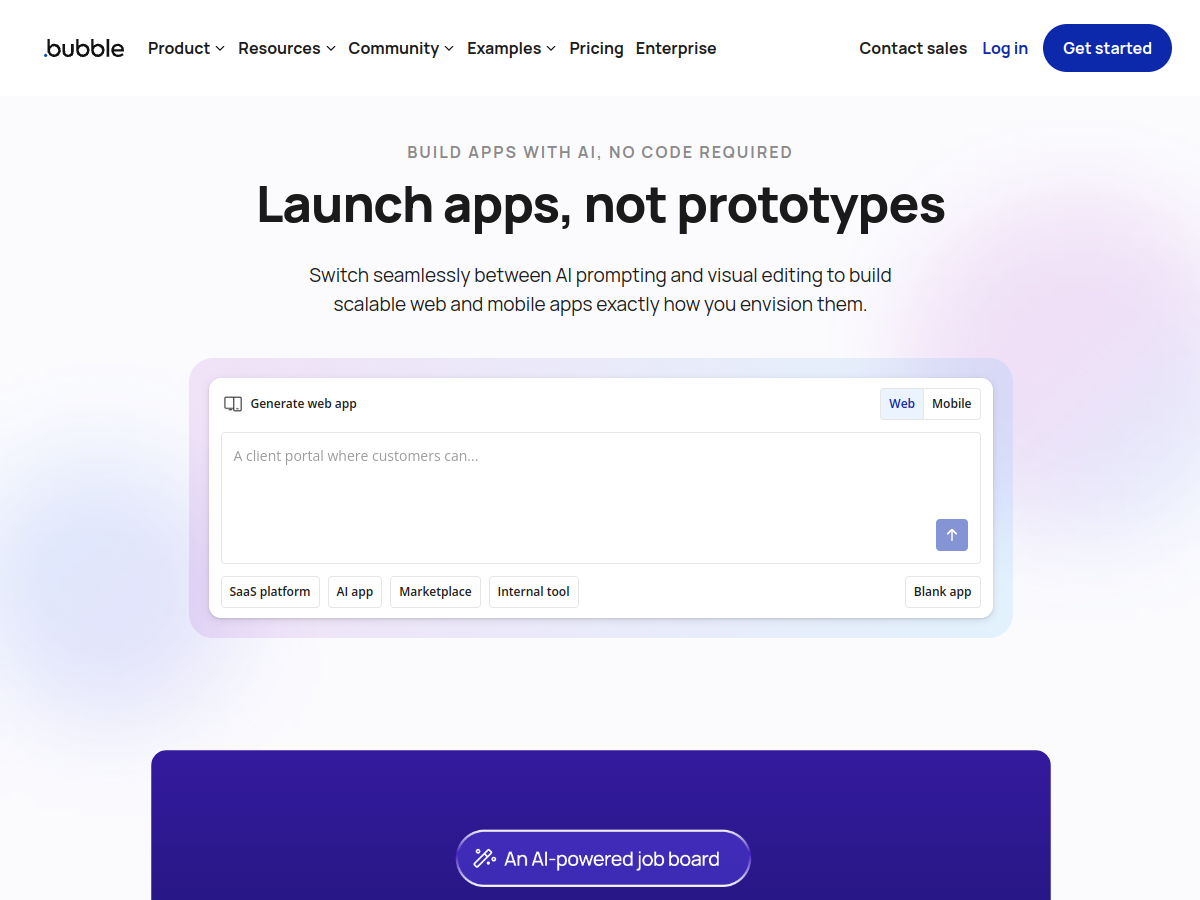
bubble.io
Details
Pros
- Free tier available
- API available
- GDPR compliant
Cons
- No EU server location
Profile: Bubble
| Company | Bubble |
| Type | Automation & No-Code |
| Founded | 2012 |
| Headquarters | New York, USA |
| Server Location | US |
| GDPR Status | ✅ Compliant |
| Free Tier | Yes |
| Starting Price | $29/mo |
| Pricing Model | SUBSCRIPTION |
| Website | bubble.io |
About Bubble
Bubble is the most powerful no-code platform for building full-stack web applications. Founded in 2012, it allows non-developers to build complex, production-grade applications — including SaaS products, marketplaces, CRMs, and social networks — entirely through a visual drag-and-drop interface.
Unlike website builders like Webflow, Bubble handles both frontend and backend: user authentication, database management, API integrations, payment processing, and complex business logic are all configurable without code. The platform includes a built-in database, workflow engine, and responsive design editor.
The free plan allows unlimited development with Bubble branding. Starter ($29/mo) adds a custom domain and basic analytics. Growth ($119/mo) includes server logs and more capacity. Team ($349/mo) provides SSO and sub-apps. Enterprise offers dedicated infrastructure and SLA.
Bubble's plugin marketplace includes hundreds of pre-built components for payments (Stripe), maps (Google), charts, and more. The platform also offers the Bubble API for external integrations. Applications built on Bubble are hosted on Bubble's infrastructure with automatic scaling.
Key limitations: no native mobile app export (web apps only, though PWA is supported), performance can be slower than hand-coded applications, vendor lock-in is significant (migrating away from Bubble is essentially a rebuild), and the learning curve is steeper than simpler no-code tools. Best suited for MVPs and production apps where speed-to-market is more important than raw performance.