
Devin
🌐 Website Preview
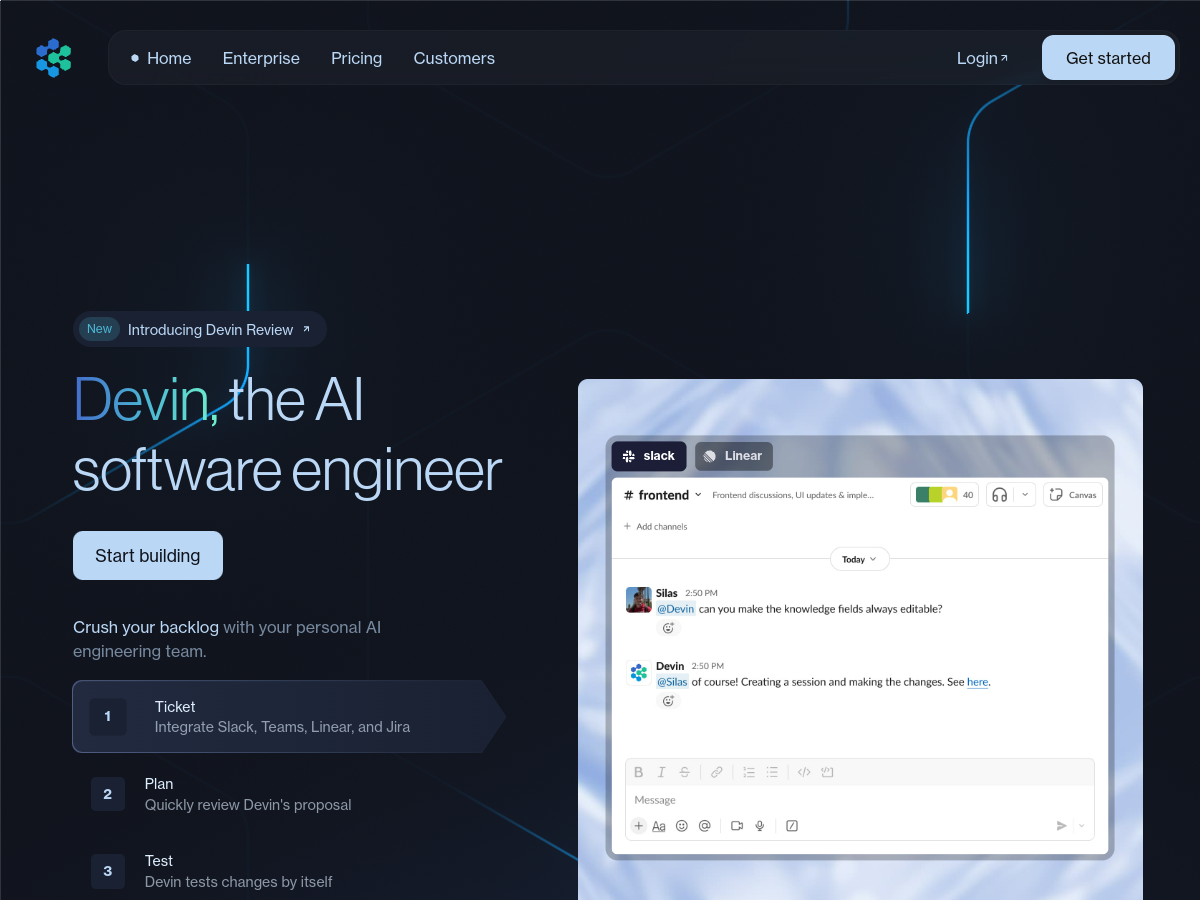
devin.ai
Details
Pros
- API available
- Codebase indexing
- Agentic workflows
- Multi-file edits
- Terminal integration
Cons
- No GDPR compliance confirmed
- No EU server location
- No free tier
Profile: Devin
| Company | Devin |
| Type | Coding |
| Founded | 2024 |
| Headquarters | New York, USA |
| Server Location | US |
| GDPR Status | ⚠️ Not confirmed |
| Free Tier | No |
| Starting Price | $20/mo |
| Pricing Model | SUBSCRIPTION |
| Website | devin.ai |
▶️ Video
About Devin
Devin, created by Cognition Labs, made headlines as the world's first fully autonomous AI software engineer. Unlike AI coding assistants that augment human developers, Devin aims to independently handle complete software engineering tasks — from understanding requirements to writing code, debugging, testing, and deploying applications.
The platform operates through a web-based IDE where users assign tasks to Devin through natural language. Devin then autonomously plans the approach, writes code across multiple files, uses a built-in terminal and browser, runs tests, and iterates until the task is complete. It can learn from an organization's codebase, understanding conventions, patterns, and architectural decisions.
Pricing positions Devin firmly in the enterprise segment: the base plan starts at $500/month for 250 ACUs (Autonomous Compute Units), with enterprise plans at custom pricing. This pricing reflects Devin's positioning as a virtual team member rather than a developer tool — organizations evaluate it against the cost of hiring additional engineers rather than against $20/month coding assistants.
Devin's strongest capability is handling well-defined engineering tasks without human supervision. Bug fixes, feature implementations following established patterns, test writing, documentation updates, and dependency upgrades are all within its autonomous capability. The platform can also browse the web for documentation, use APIs, and deploy to production environments.
The primary limitations are significant: Devin struggles with ambiguous requirements, novel architectural decisions, and tasks requiring deep domain expertise. The $500/month entry price makes it impractical for individual developers and small teams. Output quality can be inconsistent on complex tasks, requiring human review. For organizations with a high volume of well-defined engineering tasks, Devin offers a glimpse into the future of autonomous software development. For most developers today, it remains more experimental than practical.